04Jun 2026
table of contents
Generators are essential components in electrical systems, supplying reliable power to homes, industries, and critical infrastructure. Although they are designed to deliver power, abnormal conditions can sometimes cause power to flow back into the generator, which may damage the engine and connected equipment. Reverse power protection is used to prevent this condition and protect the generator from the harmful effects of reverse power flow, helping to extend its service life.
Understanding reverse power protection is important for engineers, technicians, and anyone involved in generator operation. It covers its meaning, causes, working principles, types, installation, and practical benefits etc.
Reverse power occurs when a generator absorbs power from the bus or grid instead of supplying it. In normal operation, a generator converts mechanical energy from an engine or turbine into electrical energy and delivers it to the load or grid. However, under abnormal conditions, this flow can reverse, causing power from the grid to enter the generator. Instead of producing electricity, the generator begins consuming it and behaves like a motor.
Reverse power is measured in watts or kilowatts, and even small amounts of reverse power flow can cause significant damage if not detected quickly.
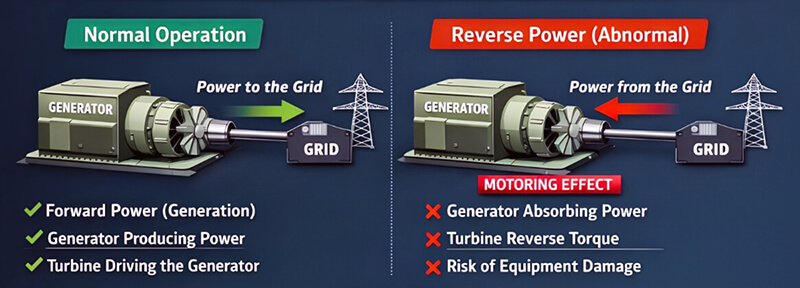
Several situations can lead to reverse power conditions, including:
Loss of prime mover input: If the prime mover, such as a diesel engine or steam turbine, loses its fuel supply or mechanical input, the generator may stop producing power and instead be driven by the connected system. This prime mover failure results in insufficient mechanical energy to sustain normal generation.
Improper synchronization: When multiple generators operate in parallel, incorrect synchronization can cause abnormal power flow between units, which may lead to reverse power conditions.
Load loss: A sudden reduction or loss of load while the generator is operating at high speed can cause motoring, where the generator begins to absorb energy from the grid instead of supplying it.
Grid faults or voltage fluctuations: Abnormal voltage conditions or disturbances in the connected grid or bus can result in reverse current flow, which may lead to reverse power if not corrected quickly.
Mechanical failures: Mechanical issues such as broken bearings, damaged couplings, or misalignment can reduce or eliminate effective torque, causing the generator to lose its ability to generate power and potentially enter a reverse power condition.
Reverse power protection works by detecting when a generator starts absorbing power from the grid instead of supplying it. It continuously monitors power flow direction to ensure the generator is operating correctly. This is achieved using a reverse power relay that supervises the generator in real time. If reverse power is detected, the system acts immediately to prevent damage.
Power measurement: The relay measures voltage and current at the generator terminals and calculates real (active) power. This is done using:
P = V × I × cos(ϕ)
V = voltage
I = current
ϕ = phase angle between voltage and current
This calculation determines how much power the generator is supplying or absorbing.
Direction detection: The relay evaluates the phase relationship between voltage and current to determine power direction.
Trip mechanism: When calculated power becomes negative and exceeds a preset threshold, it indicates that the generator is absorbing power from the grid. If this condition persists beyond the set limit, the relay sends a trip signal to the circuit breaker, disconnecting the generator and preventing motoring and mechanical damage.
Time delay: A short time delay is included to avoid unnecessary tripping during temporary conditions such as start-up, sudden load changes, or synchronization between parallel generators. This delay typically ranges from 0.5 to 2 seconds, allowing brief disturbances without triggering protection.
This process ensures that reverse power conditions are quickly and reliably detected, protecting the generator, its prime mover, and the overall stability of the power system.
Reverse power relays are protective devices used to detect reverse power flow and disconnect the generator before damage occurs. Different types are used depending on technology and application.
Electromechanical relays are the traditional type used in older generator systems. They use mechanical components such as coils, springs, and magnets to detect the direction of current relative to voltage.
| Advantages | Disadvantages |
| Simple and reliable | Slower response time |
| No complex electronics required | Mechanical wear over time |
| Requires regular maintenance |
Solid-state relays use electronic components such as diodes, transistors, and resistors to detect reverse power without moving parts.
| Advantages | Disadvantages |
| Fast response | Limited programmability |
| Compact design | Requires careful calibration |
| Longer service life |
Digital relays use microprocessors to monitor electrical parameters and detect reverse power. They can also combine multiple protection functions in one device, such as overcurrent and voltage protection.
| Advantages | Disadvantages |
| High accuracy | Higher cost |
| Adjustable settings and time delays | Requires skilled configuration |
| Communication with systems like SCADA | |
| Suitable for automated control systems |
Microprocessor-based relays are advanced digital systems that integrate protection, monitoring, and communication functions in a single unit. They use advanced algorithms for accurate detection even under complex operating conditions.
| Advantages | Disadvantages |
| Very high accuracy | High cost |
| Adjustable thresholds and time delays | Requires specialized knowledge for installation and programming |
| Remote monitoring and reporting | |
| Integration with modern power plant control systems |
Proper installation of reverse power protection is essential to ensure reliable protection against reverse power flow. Incorrect installation may cause false tripping, delayed operation, or protection failure, which can damage the generator and connected equipment.
Relay location: The reverse power relay should be installed close to the generator terminals to ensure accurate voltage and current measurement. This minimizes errors caused by line losses or voltage drops over long cable runs. It is often installed inside the generator control panel for easier integration with other protective devices.
Proper wiring: Correct wiring is critical for proper operation:
Voltage inputs are taken from potential transformers (PTs) or voltage transformers (VTs).
Current inputs are taken from current transformers (CTs).
The manufacturer's wiring diagram must be followed exactly, including phase sequence and polarity.
Incorrect wiring can cause incorrect power direction detection, leading to false tripping or failure to trip.
Integration with circuit breaker: The relay must be properly connected to the generator circuit breaker. When reverse power is detected, the relay sends a trip signal to disconnect the generator immediately, preventing motoring and mechanical damage.
Coordination with other protection systems: Reverse power protection should be coordinated with other protective functions such as:
Overcurrent protection
Undervoltage protection
Overfrequency protection
Proper coordination ensures reliable operation without conflicts between relays. In advanced systems, alarm outputs may also be included for operator notification.
Setting and adjusting reverse power protection: Correct settings are necessary to avoid nuisance trips or insufficient protection.
Reverse power threshold
The reverse power threshold is typically set at 1–5% of the generator's rated output.
Too low: may cause false trips during transient conditions
Too high: may allow damaging reverse power before tripping
The correct setting depends on generator size, load conditions, and parallel operation.
Time delay setting
A time delay prevents tripping during temporary disturbances such as:
Generator start-up
Load fluctuations
Voltage dips
Synchronization in parallel operation
Typical delay values range from 0.5 to 2 seconds, depending on system dynamics. Larger generators may require longer delays to avoid nuisance tripping.
Environmental considerations: To ensure reliable operation, the relay should be protected from:
Dust and moisture
Excessive vibration
Extreme temperatures
Appropriate enclosures with suitable IP ratings should be used in harsh environments.
Commissioning and testing: After installation and configuration:
Verify all voltage and current connections
Simulate reverse power conditions using test equipment
Confirm correct tripping at set thresholds and time delays
Ensure proper system reset after operation
Record all settings and test results for future reference
Regular review: Operating conditions may change over time, so periodic maintenance is required:
Review and adjust settings when necessary
Inspect for dust, moisture, or damage
Update software for digital relays if applicable
Ensure settings remain suitable for system stability and protection
Diesel generator: Ensures the engine is protected from damage if the generator starts motoring due to fuel loss or failure of the prime mover.
Synchronous generators in power plants: Maintains system stability and protects large turbines in thermal, hydro, and nuclear power plants from reverse power conditions.
Industrial backup power systems: Prevents damage in factories and critical facilities that depend on generators during power interruptions or grid failures.
Renewable energy systems: Used in wind turbines and hydro generators to prevent reverse power flow or unwanted backfeeding into the grid.
Preventing mechanical damage : When a generator operates in reverse, the prime mover and shaft are subjected to severe stress that can lead to cracks or breakage. Reverse power protection provides a rapid response by immediately disconnecting the generator when reverse power is detected, preventing catastrophic failure. It helps protect engines, turbines, and other mechanical components from damage.
Protecting connected equipment : Reverse power flow can also affect other generators, transformers, and sensitive equipment, potentially causing overheating or power failure. Continuous monitoring of power flow direction ensures the safety of the entire system.
Maintaining system stability : Reverse power may also create system instability, including voltage fluctuations and frequency disturbances. By preventing reverse current flow, reverse power protection supports proper load sharing among parallel generators and helps maintain stable system operation.
Reducing maintenance costs : Without protection, generators exposed to reverse power experience faster wear and tear. Installing reverse power protection reduces equipment damage, repair frequency, and overall operational costs.
Improves safety: Protects both personnel and equipment from potential hazards associated with reverse power conditions.
Correct threshold setting and time delay tuning: Proper configuration is essential, as incorrect settings may lead to nuisance tripping or failure to detect reverse power. Settings must be adjusted based on the type of prime mover to ensure reliable operation without false trips during start-up or transient conditions.
Integration with digital systems: Modern systems may require programming skills and SCADA communication integration. Reverse power protection must also work in coordination with other protection systems such as overcurrent, overvoltage, and differential protection to ensure complete system safety.
Periodic testing and calibration: Regular testing is necessary to confirm proper relay operation under actual or simulated reverse power conditions. Protection devices should also be calibrated periodically to maintain accuracy and reliability.
By following these considerations, reverse power protection can effectively safeguard generators, improve operational reliability, and reduce the risk of unexpected downtime or costly repairs.
Reverse power only occurs in grid-tied systems: Stand-alone generators can also experience reverse power if the prime mover fails or there are sudden changes in load conditions.
Reverse power protection is optional: For generators of significant size, reverse power protection is essential to prevent costly mechanical and electrical damage.
Only diesel generators need protection: Reverse power protection is required for all types of generators, including steam, hydro, and wind systems, whenever they are connected to a load or grid.
Reverse power protection is an essential safety feature for generators that prevents damage caused by the reverse flow of electrical power. Fast detection and disconnection of the generator during reverse power conditions help ensure mechanical safety, system stability, and equipment longevity. Effective protection depends on proper installation, correct settings, regular testing, and routine maintenance. When properly implemented, reverse power protection reduces costs and improves the reliability and safety of the entire power system.
At BISON, we focus on designing reliable generators with advanced protection features to ensure safe, stable, and long-lasting power generation.
inquiry form here
BISON BLOG, All the latest news and views from Bison Machinery.
what's hot?

Related Articles
Open Frame vs Closed Frame Generators: What's the Difference? Generator Backfires why is my generator draining oil what is reverse power protection in a generator does my generator have a bonded or floating neutral?Related Products